

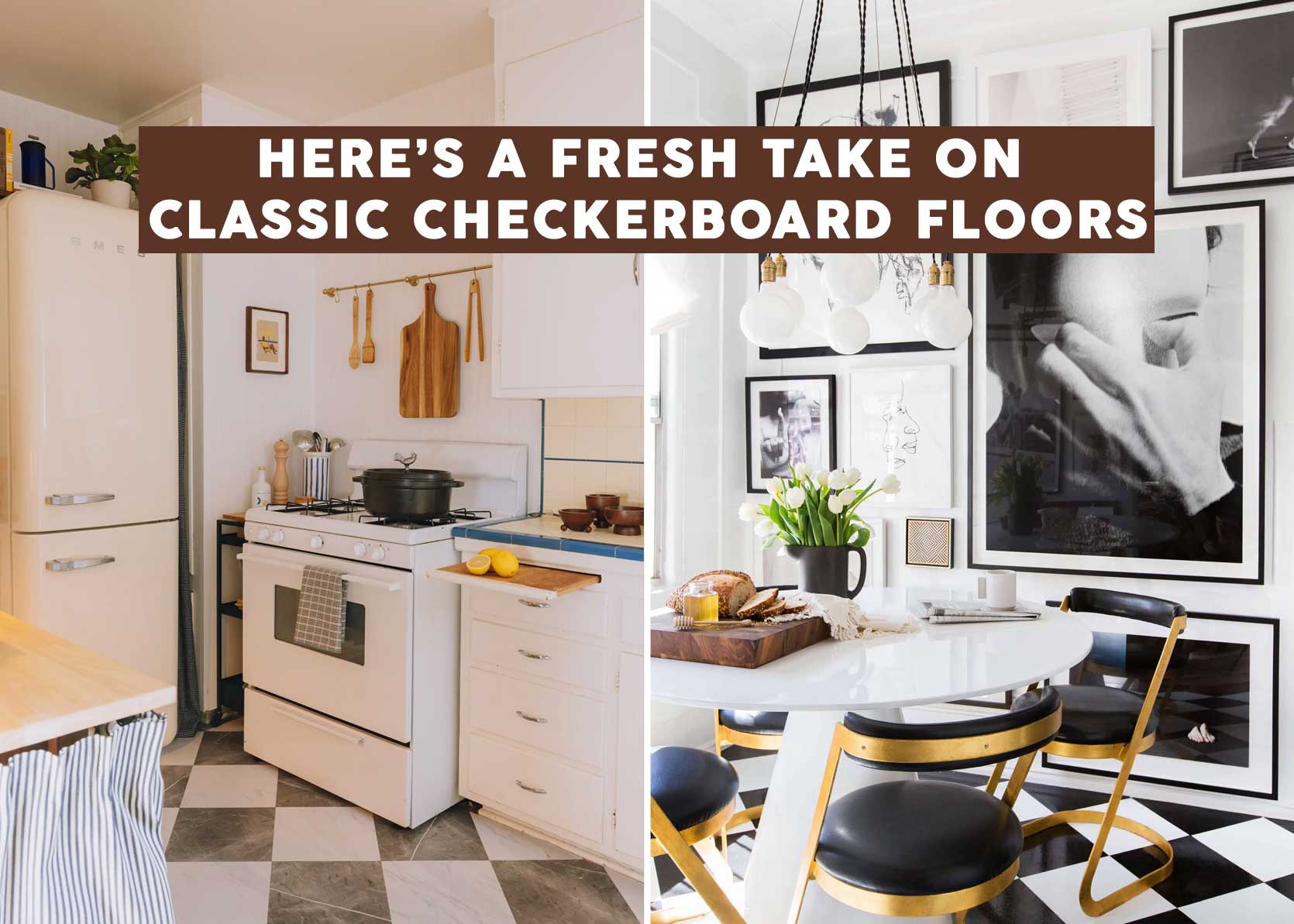
Checkerboard floors are a classic. They will never go out of style. I want to settle this early in this post because I don’t want to mince my words here. Today’s post isn’t about this alternative floor pattern going out of vogue; In fact, quite the opposite. Checkerboard is absolutely everywhere, largely because of how accessible it has become with so many great tenant-friendly peel-and-stick products on the market. It is the preferred flooring choice of many design material manufacturers; A treat to add flair to modern or traditional rooms alike.
For this reason, if you’re like me, you may be tired of seeing it as the default in home after home. Attractive? Yes! Novel or innovative? No, for those who want something with a lot more graphic punch that feels fresh and a little more interesting, I have some new ideas for you! The 10 alternative patterns I selected today all have similar characteristics to the checkerboard:
- Alternate colors (often in high contrast)
- geometric and graphic, composed mostly of squares and rectangles
- Timeless appeal, as something that will work in multiple room styles
- clean but porous
Now, before we continue, I want to warn you: I made up all of these tile pattern names. None of these are official, so please don’t go to your contractor or tile setter and say, “Please give me two-color basketweave” or “Do you know how to make an alternating rectangular checkerboard?” Because they’ll probably look at you with a scowling, confused face. But, you can definitely show them some pictures, and they’ll understand!
#1: Alternative Rectangle Checkerboard
This is the most diverse and filling option, and depending on the color choice and material selection, this combo of thin and thick rectangles can look super modern (unlike checkerboard) or like it’s been around for 100 years.
It’s hard for me to tell here whether we’re dealing with squares or wide rectangles separated by thinner rectangles, but clearly, either way would be a new take on the checkerboard pattern. The main thing here is to meet the corners of each long and thin tile.
I originally picked this up, thinking that the cream and rust sections were two separate tiles that were put together to form a grid, but now I realize that they’re actually one tile, and it’s just square tiles placed on top of each other, but flipped back and forth in each row. Either way, inspiration can still be taken if using solid colored tiles.
This, which I found again on Xia Tile’s profile, is similar but without the horizontal shift. An Ikea-like palette isn’t for everyone (including me, TBH), but the pattern itself is perfect for coming to life in many ways depending on the color choice. I love how clean and neat it is, which would work really well in a more contemporary home, although I could definitely see it taking on a more classic look if done in marble, terracotta, or zellige.
You can see how different that pattern looks in more neutral, earthy tones (and in marble). This one, by Studio KitaFeaturing a long rectangle, which fits the floor of such a space to guide the eye along the cool architecture.
If two colors aren’t enough for you, this tri-color marble application is extremely attractive. A kind of broken bar with another broken bar passing vertically through it, custom-designed by the back pair ome dezin.
A subtle change in proportion makes such a difference, as the square and squatter rectangle seem less modern, like something worn in a home from the last century (and I don’t mean the 1990s). Canales & Co. Interiors Went with a low-contrast color pairing, which is really my heart at the moment.
#2: Same-Tile Square Grid
I didn’t go into this post thinking it was going to involve just a few square tiles of the same color. But listen to me! It checks a few shared boxes: streamlined, classic, and eye-catching if you choose a saturated tone.
Maybe it’s other objects in the room that reflect the high gloss finish, or maybe the tiles are a little different, but the latter – finished with hand-glazed tile – keeps this style from looking too ’80s. designer Andrew Brown Concrete grid used in a bathroom in the Dominican Republic, published in Veranda magazine.
Okay, so not exactly solid in color, but I wanted to include it anyway because it’s a single tile that has sweet little corner details that come together to form something bigger than themselves, like a checkerboard. W Design Collective I used Delft-inspired tile in both the bathroom and the kitchen/pantry, and I love it.
#3: Two-Color Basket Weave
This whole house, by Elena UchaevaVery warm, inviting and beautiful, and floors are a big part of that design equation. Here in this hallway, she went with a basket weave pattern with a brown-red center and grout lines. This may be too much fuss for some eyes that prefer quiet, uninterrupted patterns, but for me, it’s enough interest in an otherwise peaceful space.
#4: Diamond (and Square) Accent Grid
This floor tile design, with its diamonds and cut-out squares, is as classic as traditional checkerboard, but with much less saturation in the market. It’s also lower in contrast and much more subtle, which may be suitable for the home of someone who wants a touch of graphic punch but without the intensity of checkerboard.
Mosaic floor in this bathroom Meghan Eisenberg It is very beautiful! The small detail of the added white square makes an interesting but concise statement. Same black-and-white combination, just a little different.
#5: Alternative Square Grid
Similar to the first category of this post, this pattern has been trending a lot lately, and I love it. It consists of a larger square and a smaller square which are placed in a diagonal direction from each other.
I am very impressed with him this kitchen space In a rental cabin near Big Bear Lake, California. The floor has a lot of impact but still feels connected to the ground, possibly because of the terra-cotta color.
Here’s a smaller version, with larger squares of additional color to get a little closer to the beloved checkerboard scheme.
Remember I mentioned two images Elena Uchaeva? This is another spot in the beautiful home I shared under the Basketweave section. This flooring has a completely different pattern, but is made of the same color, creating harmony throughout the house, but with a different personality for each room.
#6: Checkerboard Border
Maybe it’s cheating, like using that word in its definition. But I still want to point it out as an option because it’s like a checkerboard amuse-bouche. Just a slight change in the look so that it is not the entire visual meal, just a part of it. You can do it in any application, like upstairs in the bathroom, on the floor, on the wall, really anywhere. Make sure the scale of the tile matches the surface it is on.
#7: plaid
Caitlin has written about plaid tile before, so if you like this look, I suggest you read her deep dive (no one can deep dive like that lady!), but I’ve collected a few more examples here as viable checkerboard replacements. In some cases, it is a more complex plaid mosaic; In others, it is a reconfigured checkerboard with an additional color in the mix.
Here’s an example of a more elaborate mosaic plaid (aka more expensive, because more tiles equals more cuts and more specification to lay out properly). But it sure is entertaining and fun, right?
This plaid design is created using tiles of the same size across the board, but in three colors, laid out in a plaid-like shape.
#8: Stacked Checker Grid
If you really love checkerboard and don’t want to go too far, let me introduce you to what I’m calling the “Stacked Checker Grid”. At this point, I’m just throwing names like Spaghetti at the walls, but basically, it’s a checkerboard grid made of either non-square shaped tiles stacked to form an actual square, or smaller squares that form a larger square.
I found this casual snapshot of a beautiful bathroom sarah sherman samuel On to his feed, and the floor here is a perfect example of that. Two rectangles of the same color together form a visual square. The grout line in the middle creates more texture and interest.
And here, four smaller squares of each color combine to form a larger square, resulting in a checkered grid but with a little more oomph.
#9: Scattered Color Square Grid
For something more eclectic and visually organic vibe, there’s the “scattered color square grid” tile installation technique, which basically involves taking at least three colors of square tile of the same size and scattering them randomly across your surface. It’s fun, quirky and cute.
#10: Micro Checkerboard
And finally, here’s another “you’re cheating” moment, but I stand by its inclusion regardless. Micro checkerboard mosaic (bonus points for a border in a different pattern) is an option that works in a smaller space, like a bathroom, entryway, or compact kitchen. I’d keep the grout dark here to limit how dirty it can get, but it adds a sharpness you can’t get with larger 12-by-12 tiles.
—
If you like the look but want a little something different, my 10 checkerboard tile options are your go-to. As you can see, getting a fresh take on a classic motif doesn’t require any major changes. They’re all cute and have their own quirks, as do the originals, and it’s fun to explore little offshoots of beloved designs. If you have any others you’d like to see me include, just let me know in the comments.
Until next time, friends.
Opening Image Credit: Left: By Design Mallory Wackerman | photo by lyle nelson | From: Mallory’s 1950s DIY Kitchen Makeover (You Won’t Believe This Before and After) | Right: by design Brady Tolbert | photo by Tessa Newstad | From: Brady’s Kitchen Reveal
