

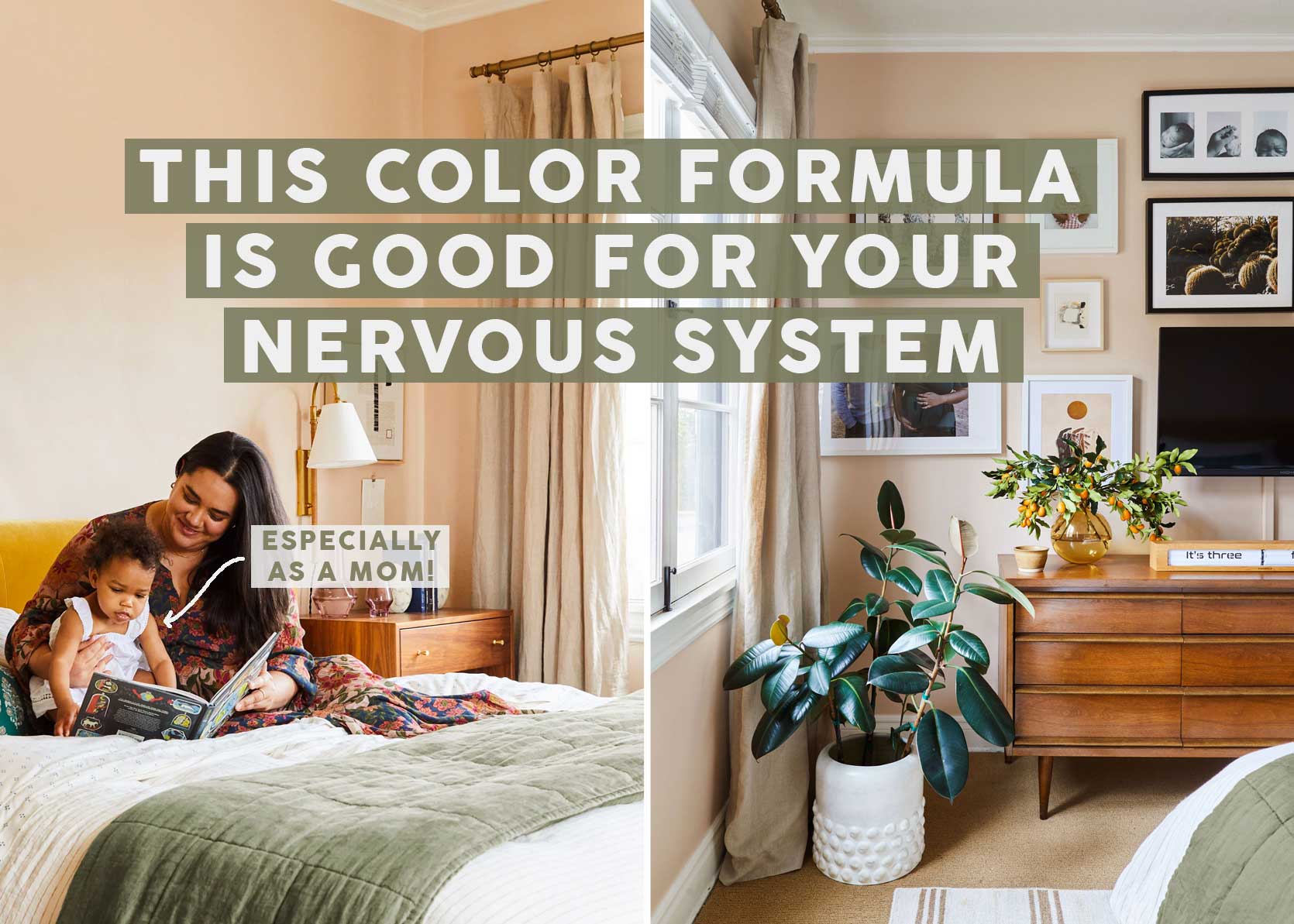
When you write about design and decor like I do, you see Very Of rooms. And when you love interior decorating as much as I do, you’re bound to stumble upon a lot of looks and styles along the way. Because of this it’s hard for me to pin down my desired aesthetic, but I know I’m very attracted to colors. You should see a saved folder on my Instagram and Pinterest accounts. It’s all blue, yellow, burgundy, peach, mustard, olive and of course a little creamy beige.
But while being able to declare my exact design style seems impossible, I’ve learned something about myself: My nervous system can’t handle too much contrast. This is a new development in my life, at least since I became a mother. Let me draw a picture for you. As I’m writing this post, I’m sitting on my couch, looking around my living room and I see the following in my direct line of sight: a play ice cream counter above my DVD player (yes, we still have one of those for library movies), a built-in marble run, a toddler shopping cart and baby stroller, a Little People’s Farm, a wooden train… you get the point.
Sure, it would help to have a playroom where it could all be kept, but that’s how we live in our house: completely out of the box and in every room. All this extra clutter and occasional disorganization causes one thing for me – a nervous breakdown. Add to this a bright blue sofa against a white wall and a dark red floor, and it is an overload for my eyes. The seating area and walls are a high-contrast combo, and the same applies to the warm-colored laminate planks against the cool velvet of our sectional.
Enter: low-contrast design, or I’m attracted to it for its ability to bring peace, quiet, and to a house full of high-contrast toys.
What is low-contrast design?
If you’re wondering exactly what I mean by “low-contrast”, it’s exactly what it sounds like: a room where the materials and colors are good, low contrast. There are no black-white or bold complementary colors from opposite sides of the color wheel. Tones are repeated or coordinated, wood tones blend more seamlessly with selected colors, and everything feels more… calm, even with heavy use of color.
You might be thinking that what I’m talking about is paint-soaking, and my response to that would be: No, not at all. Sure, a room drenched in color can be classified as low contrast, but that doesn’t necessarily always apply the other way around.
Here are some characteristics of a low contrast room:
- The colors used are tonal or analogous (meaning, colors that sit next to each other on the color wheel, rather than across from them, which creates more tension and contrast).
- No sharp, bright whites or deep blacks. Let’s all think about more middle notes
- A tight color palette without too many extra colors
- Surfaces like your floors, ceilings and walls should be treated within a subtle color palette
But first: a study in high-contrast rooms
Before I tell you about some low-contrast rooms, I thought it would be helpful to look at the contrast. Every place you’ll see below is amazing; Just to be clear, this is not an example of “what not to do”. Rooms with plenty of contrast are beautiful, interesting, and full of necessary tension. But they can’t be there for everyone at every stage of life like me, while I have a young child and a lot of Material With tango in our living space.
A saturated rust sofa with light minty walls, a brown rug underfoot, a walnut wood desk, and a mahogany (I think) chair = high-contrast. Very beautiful. I love looking at it, but I’m not sure I would feel peace in my soul sitting on that couch.
Again, I’d be lucky to have such a beautiful and sleek bathroom, but a dark navy tile with white ceramic fixtures and light neutral penny hex floors is energizing.
The combination of black and white is the definition of contrast: ying and yang, light and dark, bright and moody.
You can *sort of* see the complementary colors in this room and how it creates a lot to look at (in a good way, if you’re up for it). Of course, red and green are opposites of each other, and even though it’s a plum and not a true representation of red, I think it proves my point.
There’s high-contrast, and then there’s no contrast, like this all-black monochrome room above. I just wanted to throw this in here to see the full spectrum.
Low Contrast: Color Version
Good news! Low contrast rooms can be created using color or all neutrals and both are beautiful. Let’s start with color, because that’s what I am.
Thanks to our friends/EHD alumni Velinda Helen, Julie Rose, and Grace De Assis, who designed the room above that was recently featured in House Beautiful. It was styled by Emily Bowser and shot by Sarah Ligoria-Tramp, so basically, this was the dream team. Here, he used soft green as well as various shades of cream and brown. It’s easy on the eyes, beautiful and interesting, without yelling at you.
Want something with a little more saturation? Adopt a darker tonal look in a beautiful room, like this blue story specificity + sage. The white tulip table provides some contrast, but it’s such a small part of the overall design of the space that it doesn’t overpower the rest of the lower contrast.
Here’s another angle of the same room (shot by our Sarah Ligoria-Tramp). And then, yes, there’s the contrast between the nightstand and the light bedroom, and the dark amber nightstand, the olive green rug and the blue walls, but 75% of what my eye sees is in subtle harmony with each other. The intensity of each color is pretty much the same, which does a good job of keeping it balanced while still being moody and dreamy.
Another way to do low-contrast? Keep the tones of all the colors you use the same; For example, shown in Kate Upton’s home Architectural DigestThere’s a warm tone to everything. Chartreuse (remember when I said it was one of the new “it” colors?), brick red, clay pink. Even the color of the wood has turned orange/yellow.
Low Contrast: Neutral Version
Big splashes of color aren’t for everyone or every home, so here’s how to create low contrast in neutral warm. Hint: It involves lots of hot cream, tops and ocher.
“Arlin, I see colors!” You might say to yourself in disbelief as we begin the neutral section. I know I know. But listen, it’s important that I show it, because even though the bedding is a punchy burgundy velvet, it still works very well with the super subtle peach wall; And since these are both warm colors, it matches perfectly with the mushroom-like door, pine floor and the brown wicker chair in the foreground.
Some might say this is a colorful room, but it’s actually various shades of wheat, brown and, well, some red. But still, it is the same approach. Everything else is warm except for the little blue stool in the front, so it reads very neutral together. Nothing sticks out, nothing screams look at me. It’s very easy on this overstimulated mom’s eyes and soul. ::points to himself::
Low contrast can still be done with plenty of substance and interest. This does not mean minimalism. It simply means that the background of your home or room is harmonious, so the primary red-blue-yellow Melissa & Doug train that will essentially be left right in front of that dresser won’t have to clash with the five other colors behind it. And your busy brain will thank you for it.
I have to tell you, I love the way this room looks and the way I feel inside. I feel like if I curl up on that couch, reach for a book and just sit in silence for 20 minutes (yeah yes right), all the problems in my life will go away. It’s very peaceful, easy to digest, and of course, low-contrast.
I’ve had this room bookmarked for months and it makes me very happy. I love huge kids’ art that have a moment because the rest of the space is basically the same color: cream or a shade of brown.
Here’s an example of a low-contrast corner in a more high-contrast location. The dark-stained rafters with creamy white walls in the background are the definition of contrast, but the dining alcove balances it out with an all-mid-tone arrangement.
And finally, another brown and gray living space that makes my heart skip a beat. Am I being a neutral girl? When done in an intentional and well-balanced way, well… I can see this being more and more true. My eyes become moist, my breathing slows down and everything seems right in the world (even if it isn’t at all).
—
This is where I leave you. I spent several weeks working on the low-contrast concept in my mind before presenting it to Team EHD, and I’m glad I was able to practice seeing it in action. I have a big announcement coming into my life in my next post (stay tuned!), and this post as well as my last yellow neutral post will get a lot more play from me in the weeks and months to come. Stay tuned!
Opening Image Credit: Photos by Design Arlene Hernandez (I!) Styling by Emily Bowser | by photo sarah ligoria-trump | From: 3 years in the making and then an unexpected step: The reveal of Arlene’s bedroom is a lesson in the beauty of “unfinished” design
