

Have you ever looked around a room in your house and thought, “Hmm, something isn’t quite right?” But you couldn’t understand why? Honestly, there could be a number of reasons for this, like the color palette isn’t well-rounded, the size or scale of your furniture is wrong, or maybe your curtains or art aren’t hung at the right height. But if you think all those boxes are checked to your satisfaction, something else may be going on: You don’t have the right combination of silhouette weights. Let me explain.
Most furniture and large items can be categorized into two groups – leggy and heavy – and if there isn’t a balance between these, things can feel either overly floaty or too heavy. While there are always exceptions to the rule (yes, I’m noticing them too), I took some time to study images in different rooms to figure out what the right mix of chunky (solid, low base) + leggy (slim-lined silhouette or long legs) is to strike balance in your spaces. But first, I want to give credit to Hans Lowry, who created this video On this topic a few weeks ago, which inspired me to brainstorm on this topic. Give it a watch as a primer; I will wait.
…..
………
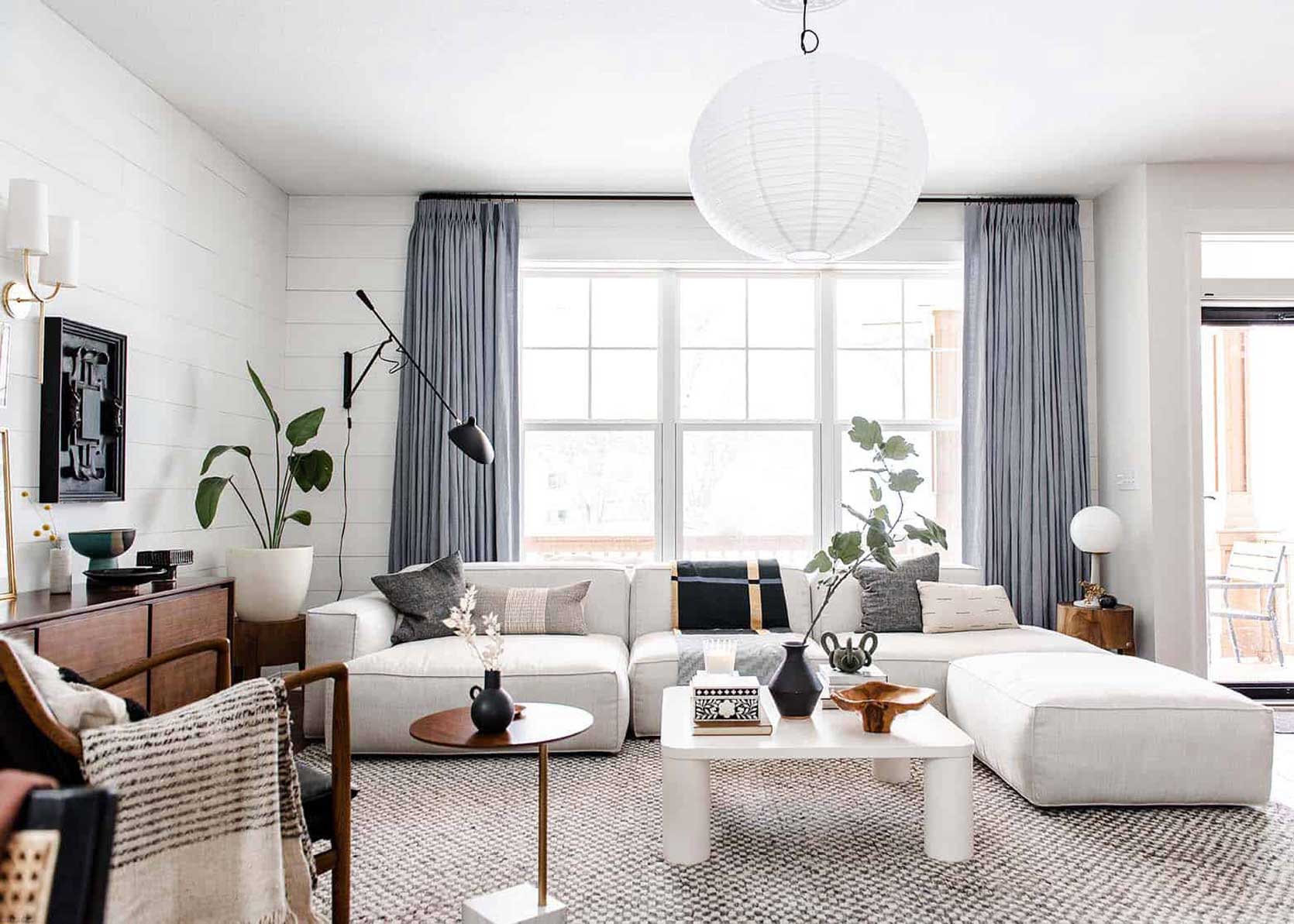
Okay, welcome back. Before we look at examples of rooms with perfect proportions, let’s hop into our home time machine and explore my previous living room. I loved that room at the time and, honestly, I still love it now when I look back, but there was always something about it that felt a little busy. Especially when life is busy with kids’ stuff, hobby items and generally all the things you collect and can’t find a place for.
So I decided to examine the furniture taking into account the ratio of thick + long legs, and now I can see why: it was all long legs, with almost no missing pieces.
Coffee table: Will. couch? Leggy (with a little bit of crumbs, thankfully). Chairs and side tables: Legi. Deepak: Will take. There is a side table below the lamp that was heavy and you can’t see in this photo, but there is also a console table to the right of this sofa that was quite long. In my eyes, it’s just lines, lines, lines, not to mention the inconvenience of all the balls and toys my child played with by rolling them under something countless times a day.
Again, I think this room looked great in many ways, and I loved being in it, but a solid/thick coffee table or more filling chairs would have elevated it to the next level. And that’s what we’re trying to do here today. Posts like this aren’t meant to shame you into “fixing” your home, but rather to help you feel a little more united, as if your designer best friend came over and helped you change a few things for the better.
The Rules of Leggy + Chunky (And When You Can Break Them)
We like to have a rule at EHD, not to lock you into something, but to help free you from analysis paralysis. Or maybe the word “guidelines” is best, because there are times when you can play around with said rules. But let’s stick to what we’re aiming for first before taking a look at some of the more challenging locations.
In the world of leggy + chunky, I believe certain proportions work best:
- 1:1 (50/50 if you’re better with fractions, or both pieces of furniture divided equally in weight)
- 1:3 (60/40, or 1 thick piece for every 3 or more legged pieces, and vice versa)
- 1:?? (Don’t be confused by the question marks, this is not a typo. I’m writing this because a single large piece that is either leggy or thick would be much better than all the contrasting types in the room.
Examples of 1:1 or 50/50
I scoured EHD’s recent collection to study some of M and the team’s work, and unsurprisingly they all follow a 1:1 or 1:3 silhouette ratio. Let’s take a look at them together.
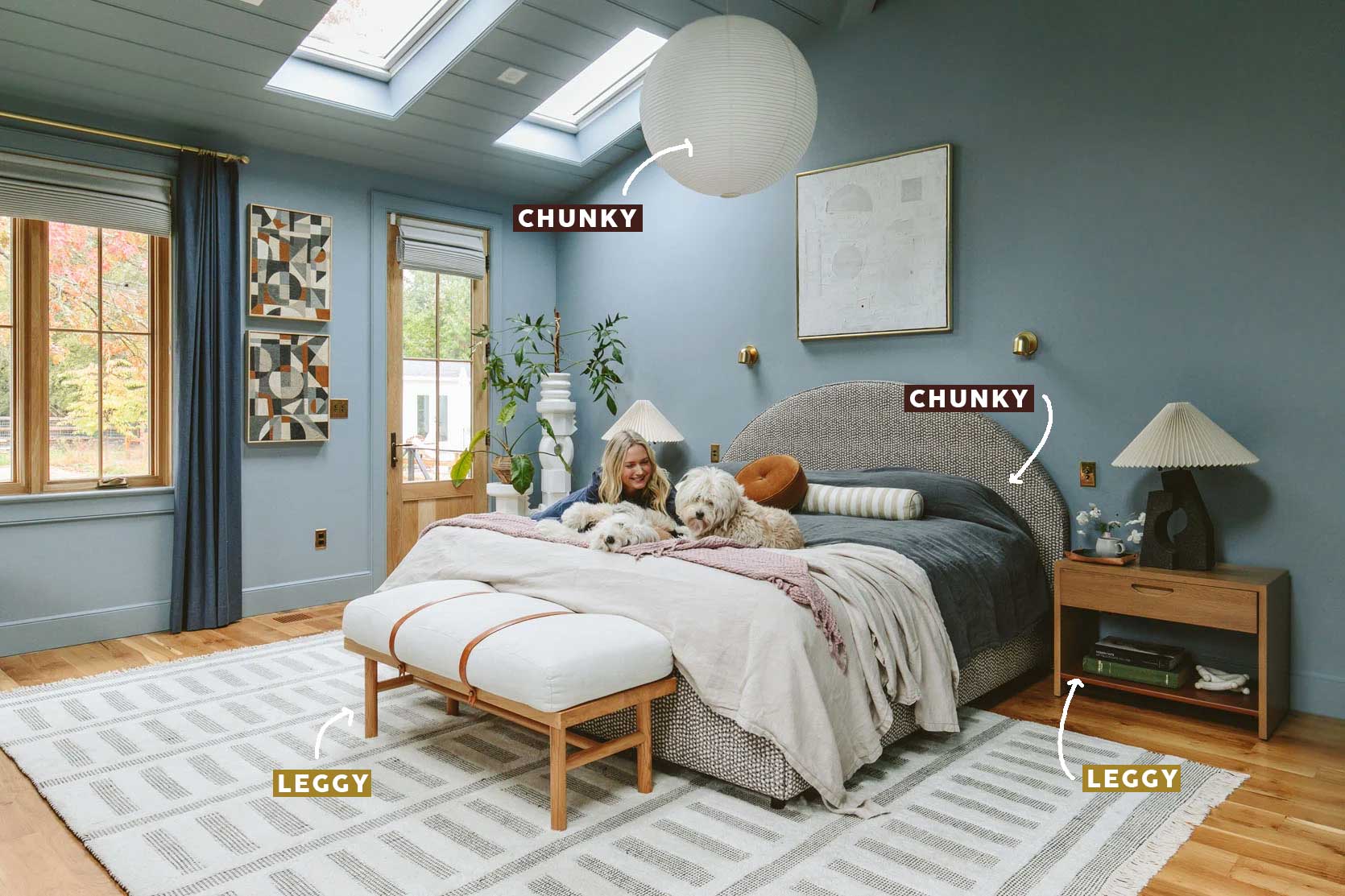
This is a view of the primary bedroom of Emily’s farmhouse. As you can see, the bench and nightstand can be labeled as leggy because they have few visible vertical lines (the nightstand, depending on the angle, can also look heavy, but from here on out, I’m calling it #teamleggy). The bed frame and pendant lamp – both solid pieces – have about a 50/50 distribution. Sure, you can take a look at table lamps, greenery, and a few other pieces to add to the equation, but the base fits the 1:1 ratio perfectly.
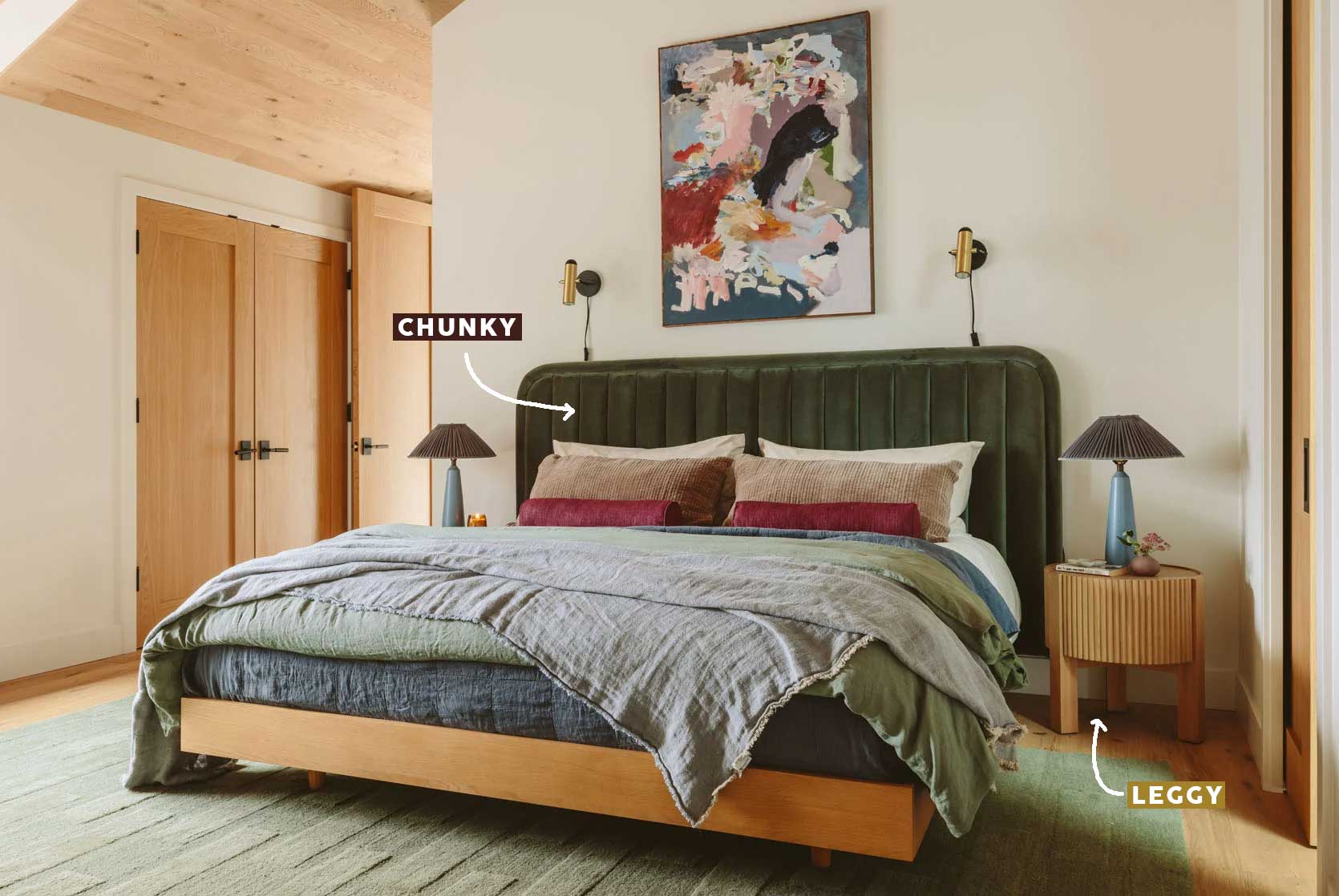
Another of Emily’s bedrooms, this time from River House. It’s quite simple: thick bed, nightstand with long legs. Boom, done. If you ever find yourself struggling with choosing a side table for your bed, remember the rule of contrast here.
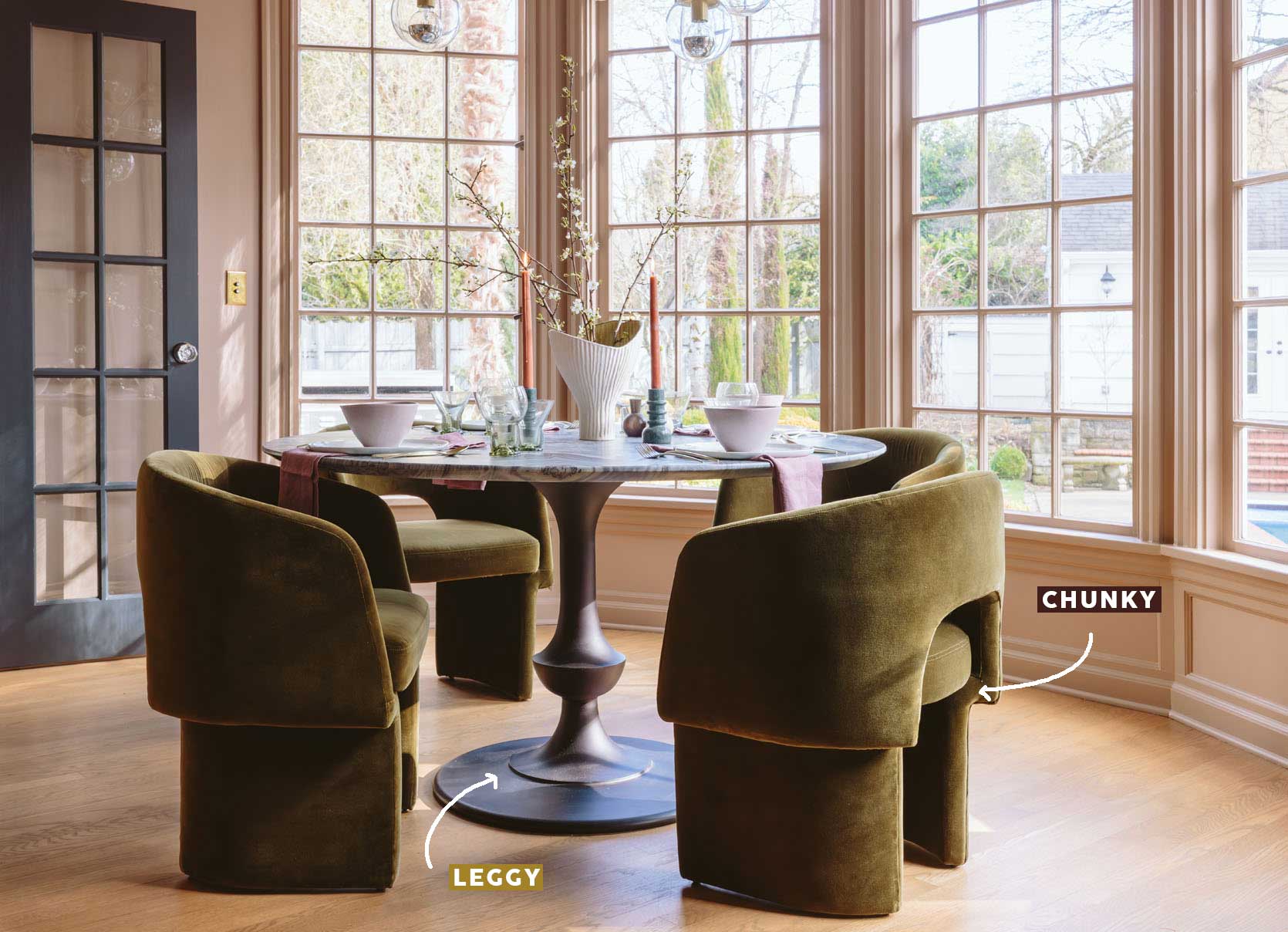
There’s a 50/50 split of action in the breakfast nook room here. Thick chairs, table with thin chairs. The many other light and airy aspects of this space also balance out the club-like chairs, but it would work just as well without the bank of windows with the delicate grid.
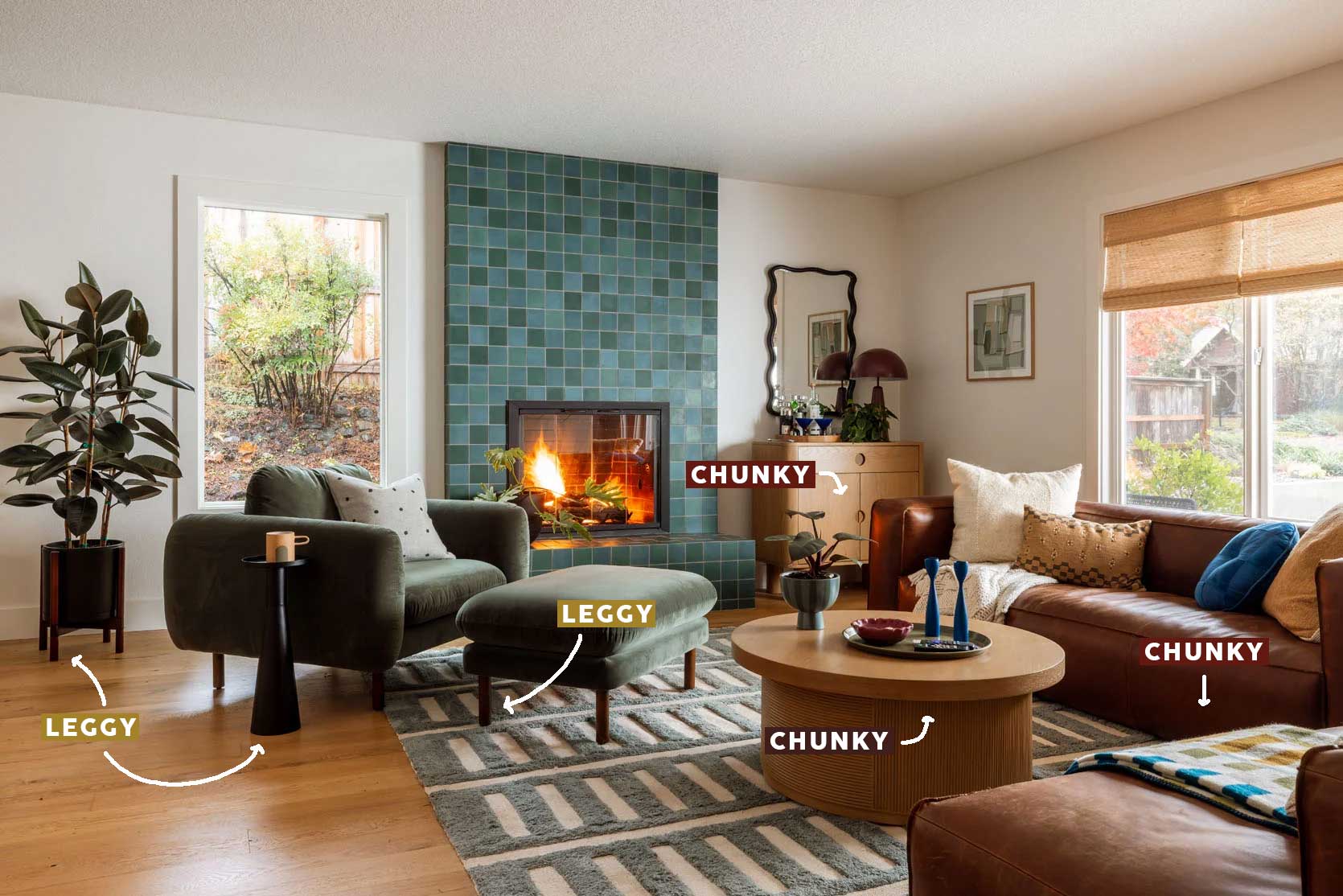
There’s a chunky piece for every leggy piece in Caitlin’s living room (chunky = sofa, coffee table, sideboard; leggy = ottoman/chair, drinks table, planter). It’s actually a nice mix of the two that feels intentional and balanced. I especially appreciate how the solid pieces are placed in the corners, and the legged objects are more in the center of the room, making the flow feel more seamless.
Examples of 1:3 (60/40)
Well, let’s look at some places with a more diverse distribution of silhouettes.
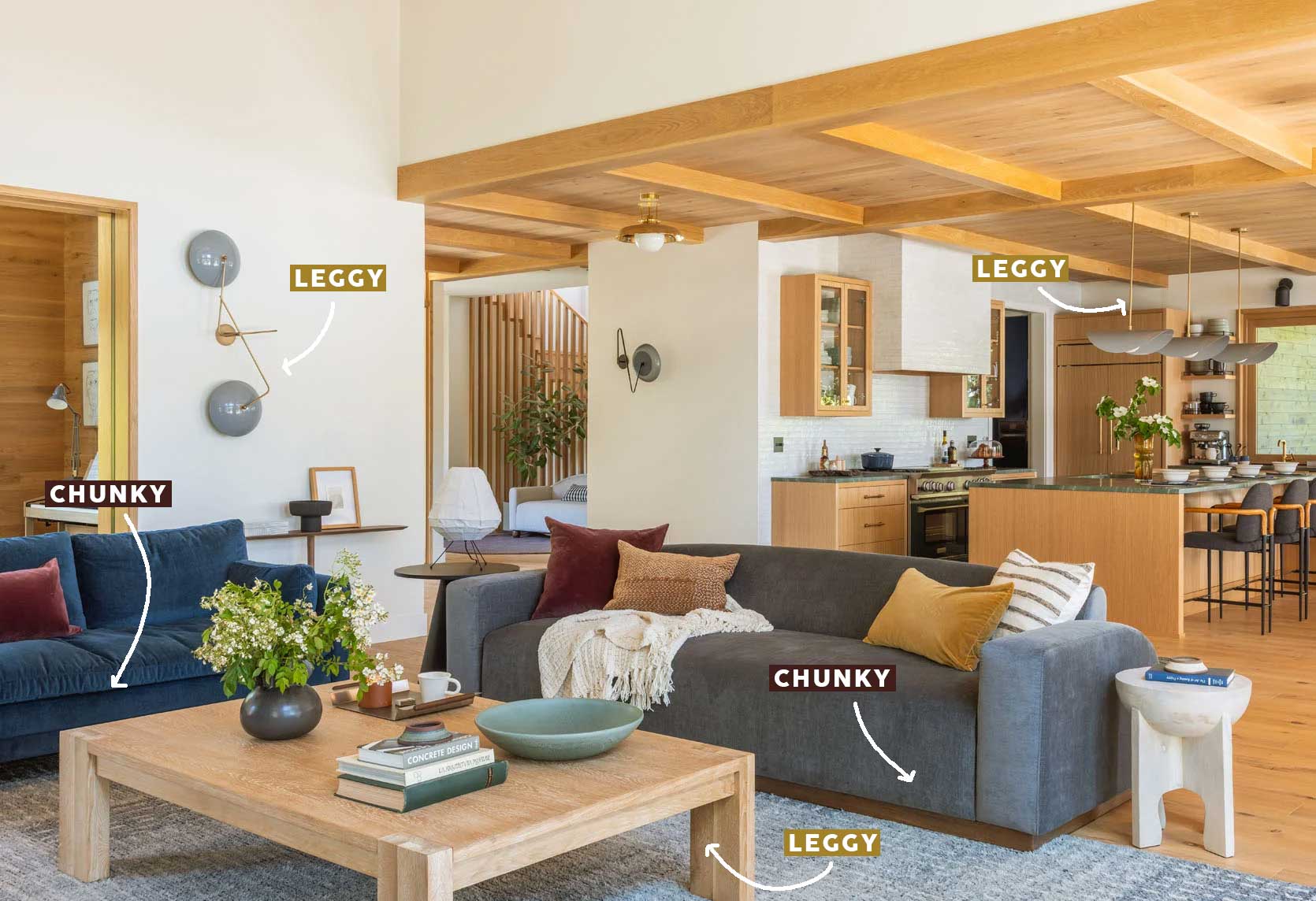
In the living room of the River House, we have a good mix of both chunky and leggy (even some I didn’t label, now I’m seeing it again). The biggest takeaway with this is to remember to consider things like lighting into this equation, because it’s not just the furniture that ties this balance. Here, you can see that the sofa and side table are on the bulky side, but the sconces and pendant light (and bar stools) introduce that slim, airiness. I’ve labeled the coffee table as leggy, but honestly it’s a chunky piece, so one can go either way.
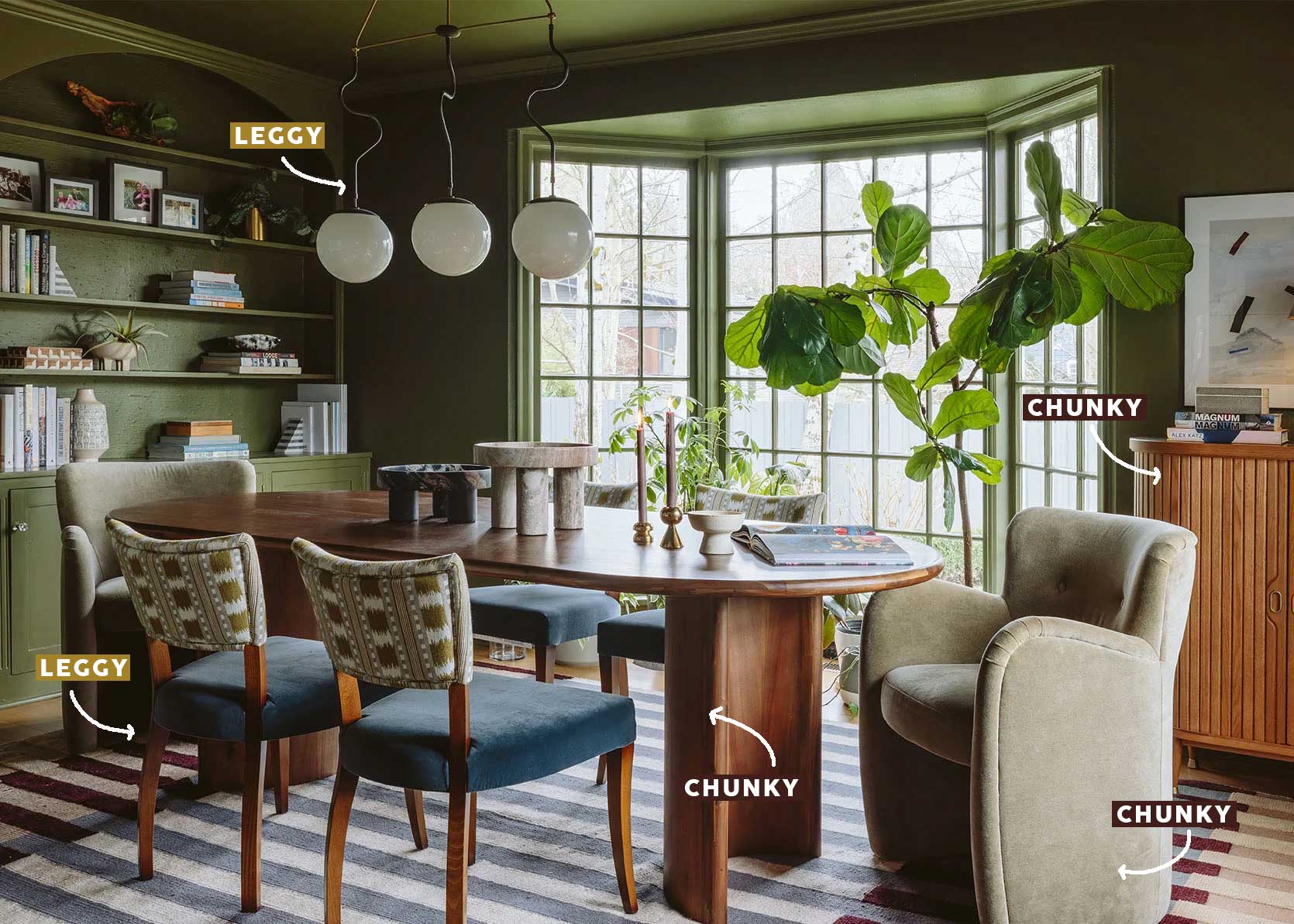
Dining rooms can be tricky, given that most tables and chairs are naturally long. Yet, here, crooked side chairs and a thin and crooked chandelier balance the solid head chairs, case goodies, and table perfectly.
rule breakers
I’m just going to say it: Some of my favorite rooms break many of the rules of design. In fact, some of the best rooms full of character and interest hang their curtains too low, or have a rug that’s too small, or yes, even go the opposite of what I’m trying to explain to you in this post. But there are a few reasons why they still look and feel good.
For example, this place, by sarah sherman samuelQuite a thick chair and chest. Yes, there’s a small long-legged stool, but even without that, the room works on some levels. Firstly, the furniture is very blocky but angled down in a space with very high ceilings, so nothing feels overly cumbersome. Additionally, the thin stripes of wallpaper and carpet serve to provide a visual contrast.
This room is at the opposite end of the previous room VSP InteriorsWhich has more legs than a centipede yet is a pretty classic English design. In a traditional home like this one, anything small and bulky will feel out of place. It’s okay to follow whatever whispers your home gives you about what it wants in terms of style. In this case, the legs completely.
Some more examples to bring it home
Let’s take a look at some other homes in different styles outside the world of EHD and see how this leggy/chunky equation works.
house of district drahanfeatured in maskA great example of my 1:?? The ratio I have discussed above. Almost everything shown in this photo, except the old Cassina Soriana armchair, is delicate and long-legged. Here, it fills the room with a touch of the unexpected (like bunnies, ha).
Another 1:?? The room, it’s beautiful and still well balanced (roofs like this can handle anything below it, TBH). Well-grounded furniture paired with a slim, triple-arm floor lamp goes a long way in adding just the right amount of tension.
i’m a big fan of zoe feldmanSo whenever I can sneak into a room with her, I take advantage of the opportunity. Here, heavy upholstery above a solid window bench is beautifully paired with a leggy table and wall sconces.
Even a traditional design like this emma ainscough A bold piece can blend in in a way that looks appropriate, although I think the modern piece of art and the eclectic chandelier help make it feel welcome at the party.
studio vale de vale A beautiful harmony was created between the heavy desk, the long chair and the lamp.
one more from zoe feldmanBut this time, a bedroom. I love the combination of the pivoting desk and chair next to the more contemporary wavy corner headboard.
And finally, it’s a very small pocket compact ibiza, spain, house Of Vicente Hernandez ZaragozaBy Romano Architects. The pencil-like table counterpoints the plinth banquette, as does the pendant light.
—
After 16 pictures of mostly do’s and don’ts, I hope you’ll feel better equipped to find some balance in your home if something is truly missing. If you’ve gone too far with leggy or thick pieces, now you know what you need. And remember, even one item 1:?? Will check the box. Ratio. Good luck friends.
Till next time…
Opening Image Credit: Design by Lee Johnson creekwood hill | photo by Sage E Imagery | From: Lee’s living room revealed: The solution to her pet and family friendly open concept design pain
