

Two years ago, right around this time, I revealed how to refresh my rental kitchen. During the months leading up to that, I chronicled my journey from “before” to “after,” and one big change was my equipment. When my family moved here, we had a partially broken white electric-coil range, a black (and ancient) dishwasher, and a very small, apartment-style fridge, also white. It was a mix of finishes and not one of the tools suited our needs.
It took me almost a full year to find new, second-hand kitchen appliances within my budget, but I finally did. The biggest accomplishment was my refrigerator, mostly because I had very specific limitations, including the need for a counter-depth model. Not only that, but the way our countertops were cut off a bit in the fridge area meant we couldn’t even accommodate a standard 36-inch width model. We needed a counter-depth fridge.
Here’s a little snippet from my kitchen about this process:
“Let me tell you… it was almost impossible to find a 33-inch fridge at counter-depth (this space requires it). I’m not exaggerating when I say they make three models that fit that bill. In the entire market. And then try to find one of those secondhand, well, Everest region ones. But I did it. And the excitement I felt is what I imagine stockbrokers feel when they stockbroker. Things that make them a lot of money. I love our fridge…it makes me so happy every day.”
So, here I am, over 700 days later…do I still like it? Am I still happy enough every day? Well, mostly, although it’s complicated. And that’s what I’m here to talk about today.
What is a counter-depth fridge, and why would someone need (or want) one?
A counter-depth refrigerator is exactly what it sounds like: a fridge that’s as deep as a standard kitchen countertop, which is typically between 24 and 30 inches, while a standard depth refrigerator can be 30 to 36 inches deep and extend beyond the countertops. So, why does it actually matter, and why did I personally choose to go with counter-depth? Glad you asked.
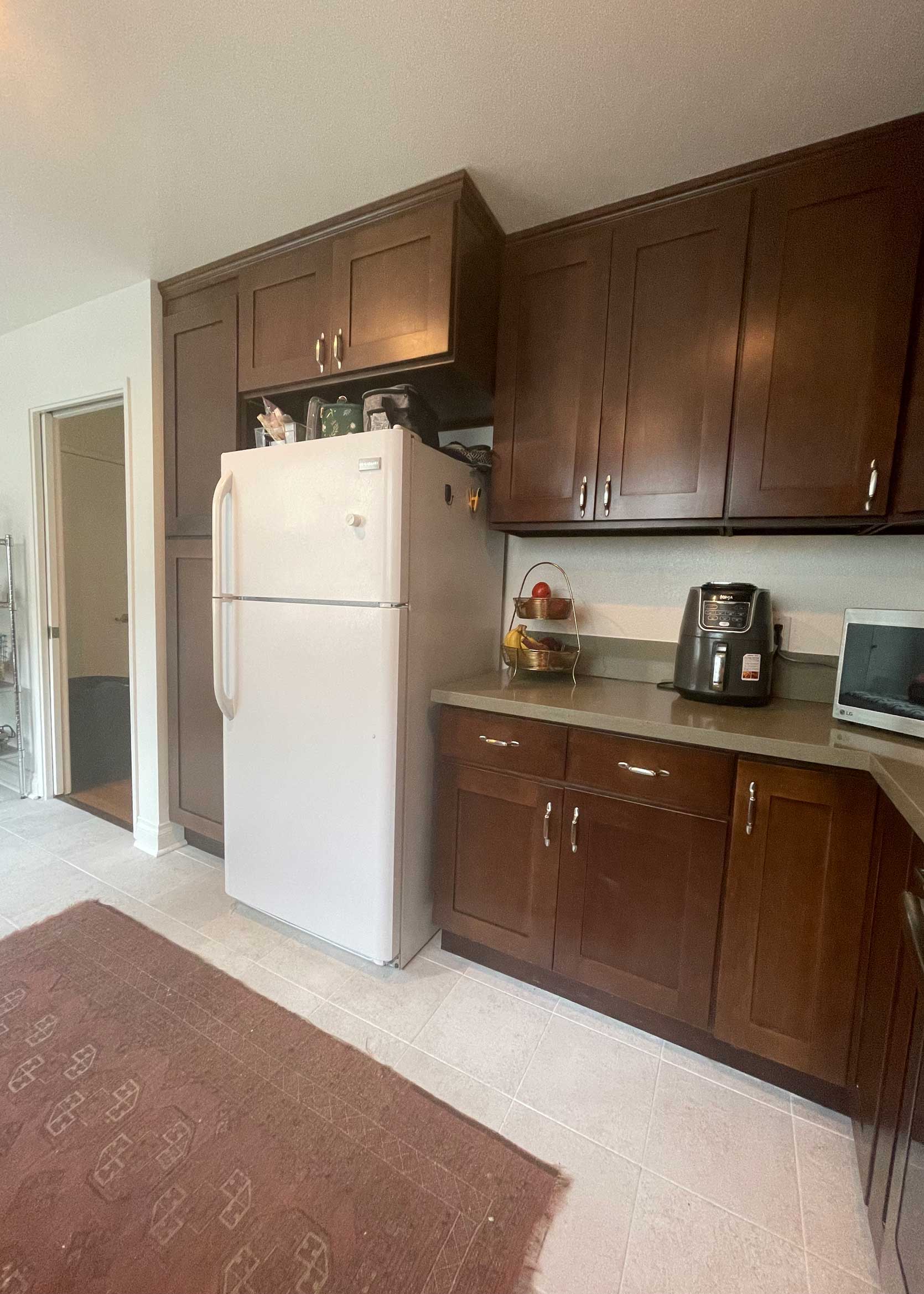
I grew up in homes where there was a built-in cabinet box that housed a standard-depth refrigerator. It looks like this:
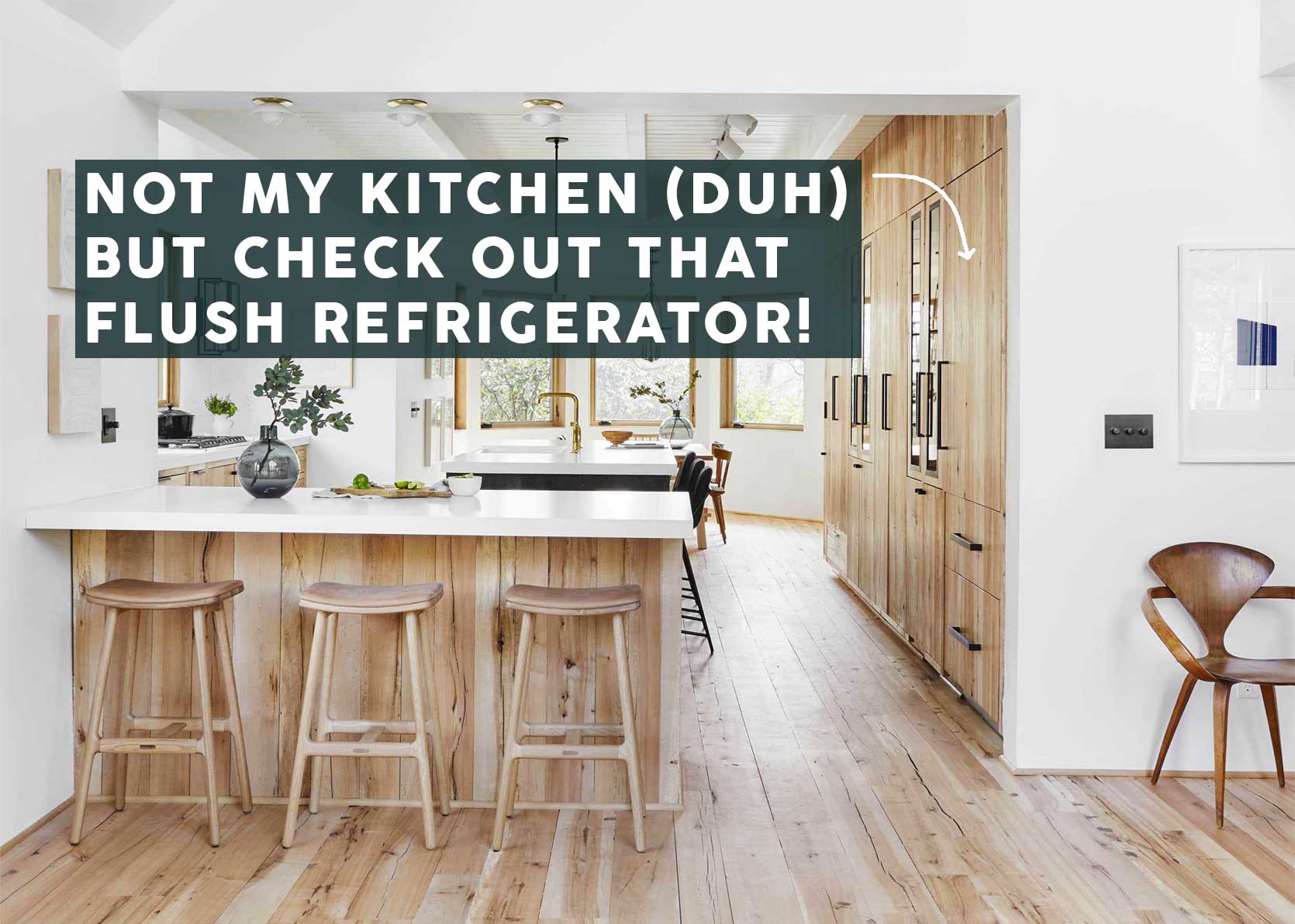
Our fridge sat nicely inside a frame that made up for their depth, with the upper cabinetry also extending more than the rest of the overhead. We also had plenty of room to move around the fridge. Some people (or mainly, designers) don’t like it because it breaks from an uninterrupted line. You can see that in the photo above. In my opinion, it certainly doesn’t look bad when well laid out, but recently it has become the norm to have a fridge, especially when integrated/panel-ready, flush with countertops and lower cabinetry.
One way to avoid this, if you care to, is to build your fridge into a floor-to-ceiling cupboard on its own wall with no counter space, like this:
Of course, none of this was my scenario. I wasn’t renovating a custom kitchen. I was just hoping to get my rental kitchen – where I spend a lot of time cooking, eating or cleaning – less “bargain basement bin” and more “nice family home.” As I mentioned at the beginning of this article, I was working around some limitations in terms of width, and after measuring, I realized that a standard-depth would extend beyond my countertops by about 10 inches. In a tight U-shaped kitchen like mine, an appliance that projects too far into the center space is not only an eyesore but also cuts off the physical and visual flow. I knew I would have to find some counter-depth because of the location my fridge was in the floor plan.
I found this great side-by-side comparison of different (note: this is not in my kitchen) on Instagram to get a sense of how far the standard-depth holds up:
Specifications of my fridge, where I bought it and what I paid for it
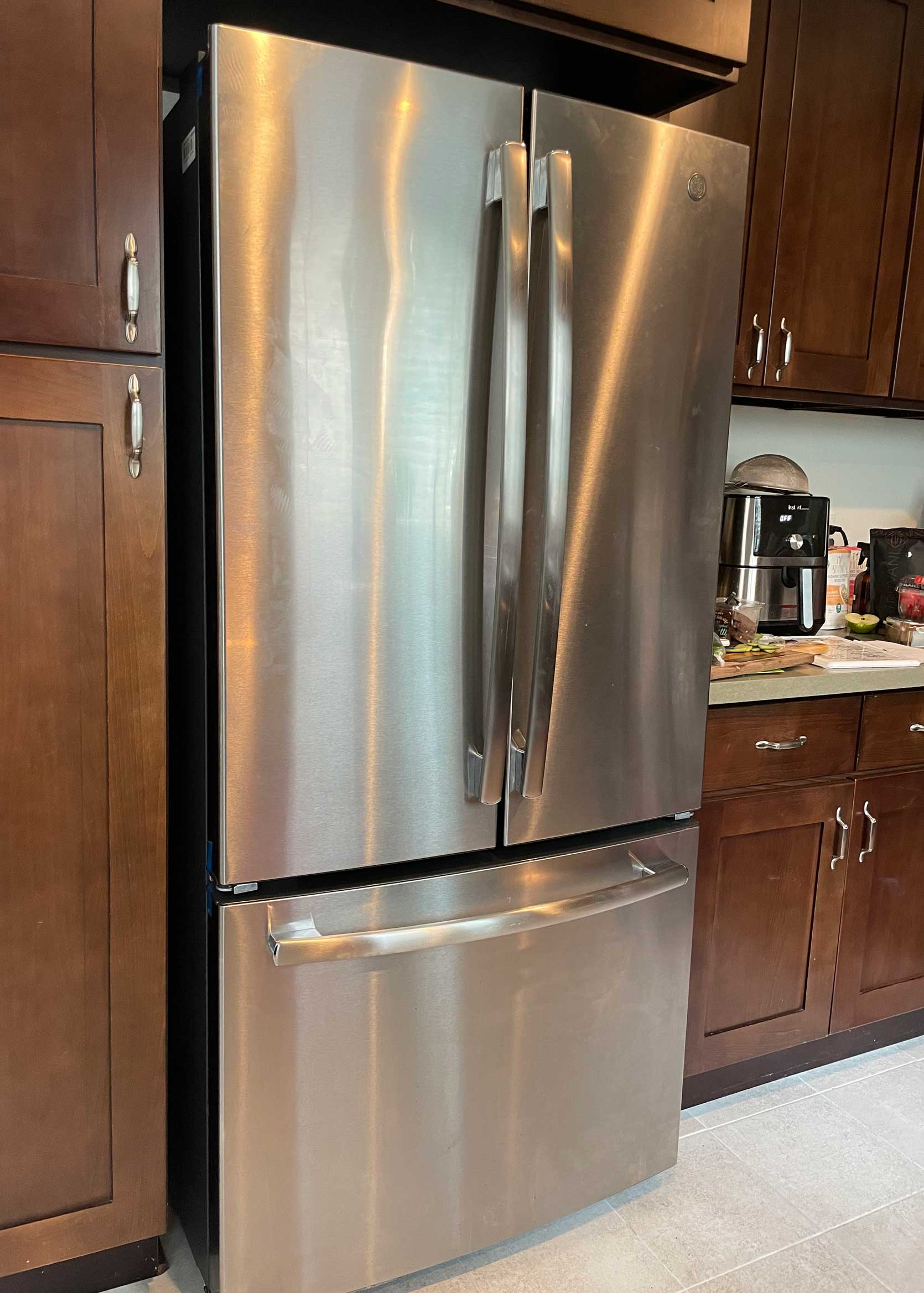
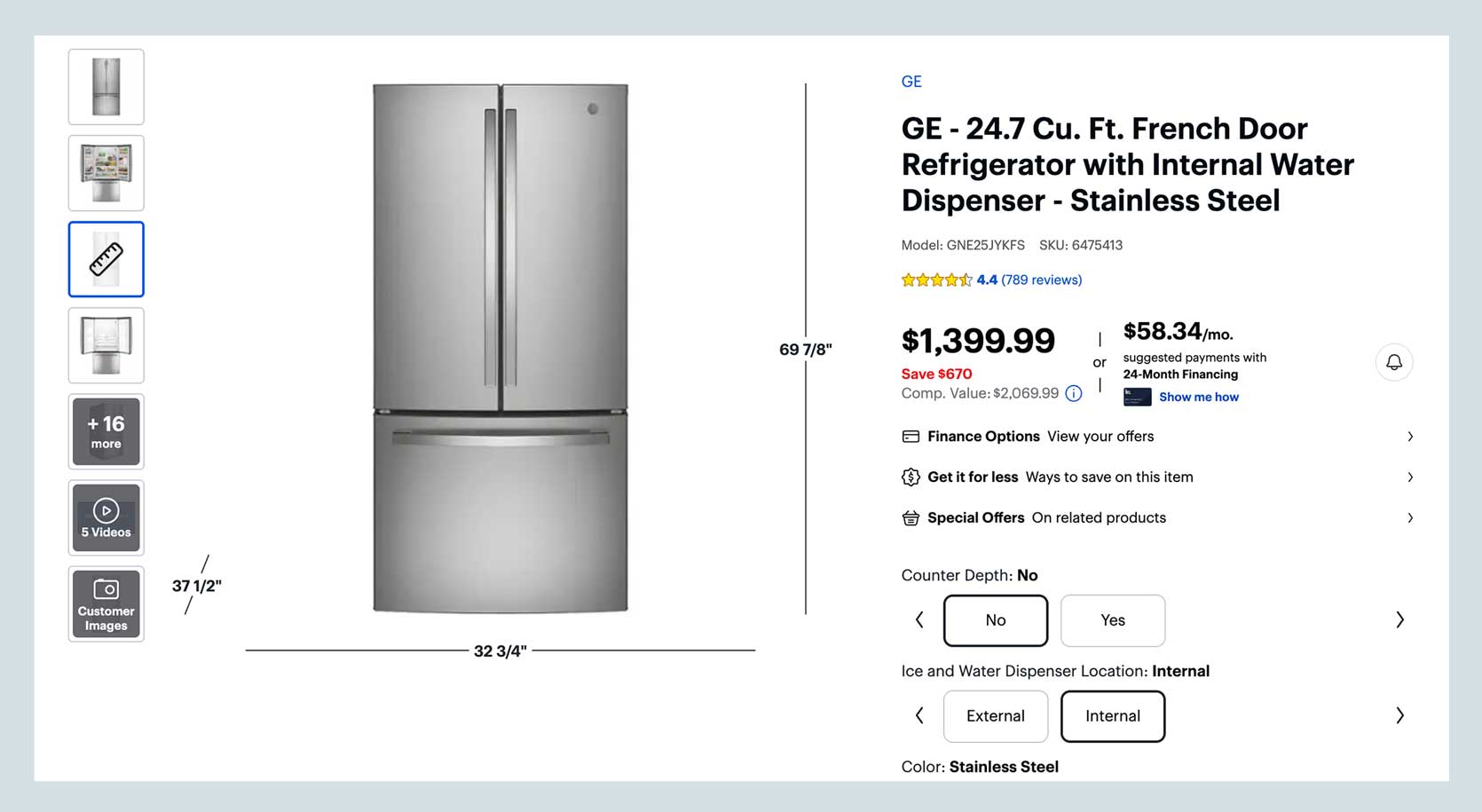
This post is not meant to be any kind of blatant endorsement of the refrigerator we found, but I wanted to include it so it would be useful to someone, and also because I wanted to show what a difference a few inches of depth can make to the interior of a fridge. Here’s the model I purchased (reminder: I purchased my model used on Facebook Marketplace for about $600).
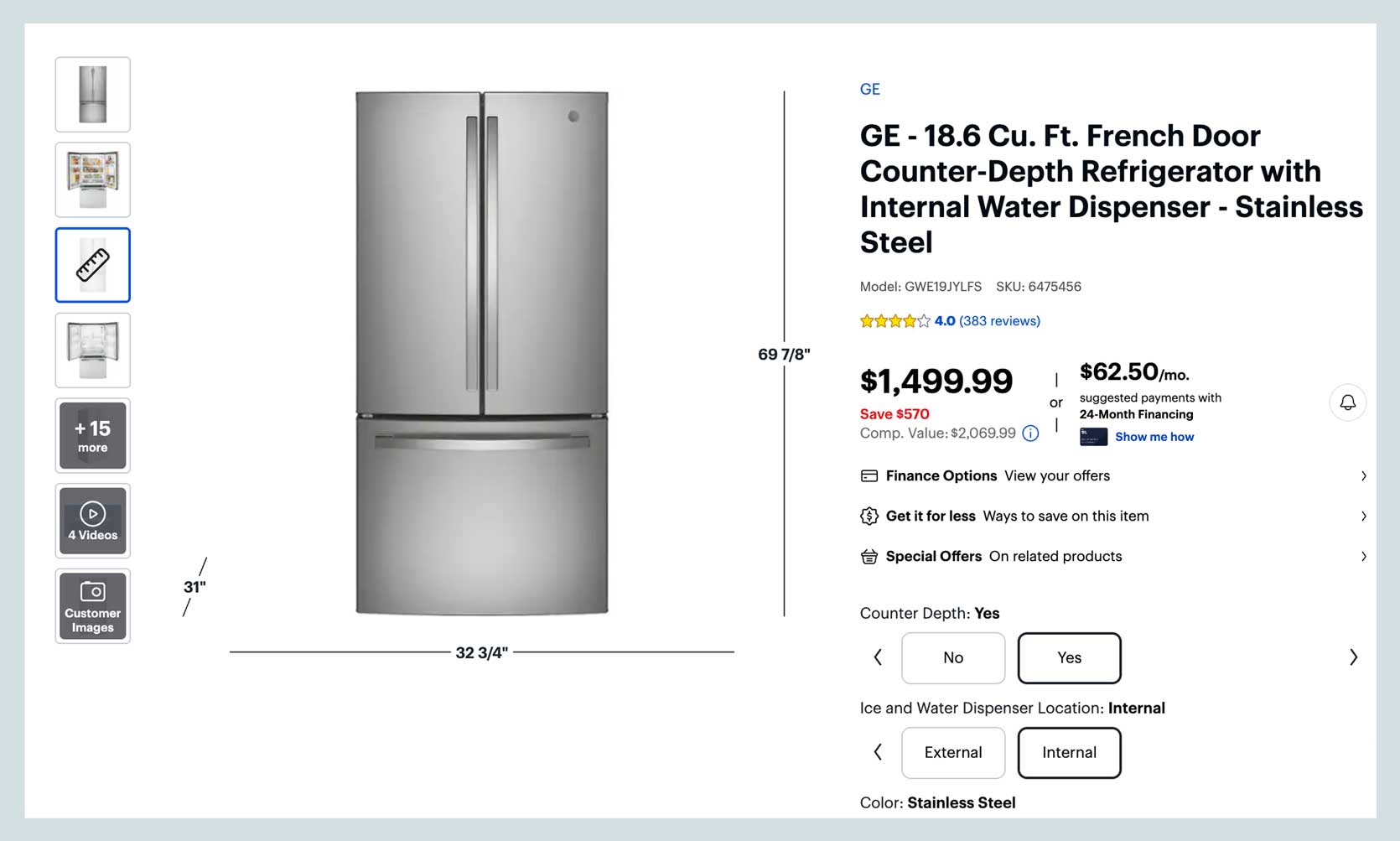
Below is the same fridge, but instead of being 31 inches deep, it’s 37.5 inches deep. (Keep in mind that the fridge itself is 36 inches, but the final dimensions include the handles.) A difference of six inches is equivalent to a difference of approximately six cubic feet. My friends, there is a lot of space inside the refrigerator. Also note that the smaller counter-depth model is $100 more expensive than a regular fridge. As far as I understand, the increase in price is mostly due to supply and demand (they simply make lower counter-depth fridges than standard depth), but also because they cost more to make.
These are important things to keep in mind if you’re considering a counter-in-depth, but my personal experience with less space, in particular, below. keep reading!
My honest thoughts, after 2 years.
There are a lot of advantages about our refrigerator, but there are also some disadvantages. Let’s start with the positives, because I’m an optimist.
professional:
- It fits! Above and beyond that, he was obviously my number one priority.
- It doesn’t stick an extra six inches in my already tight kitchen!
- Aside from the aesthetics of its size, by far the most convenient part about a counter-depth fridge is that, because it’s not as deep, food doesn’t go into the caverns of your chiller. Playing Jar Jenga is so over-stimulating for me, I push the pickles, pasta sauce and relish out of the way to get to the Kalamata olives in the back way. My fridge only has the capacity to hold things two to three times before they hit the back wall. For some people, this may be a travesty, as it limits storage, but for people like me, who often have containers of leftover food (and need to be constantly reminded that yes, I have food at home), it limits food waste significantly.
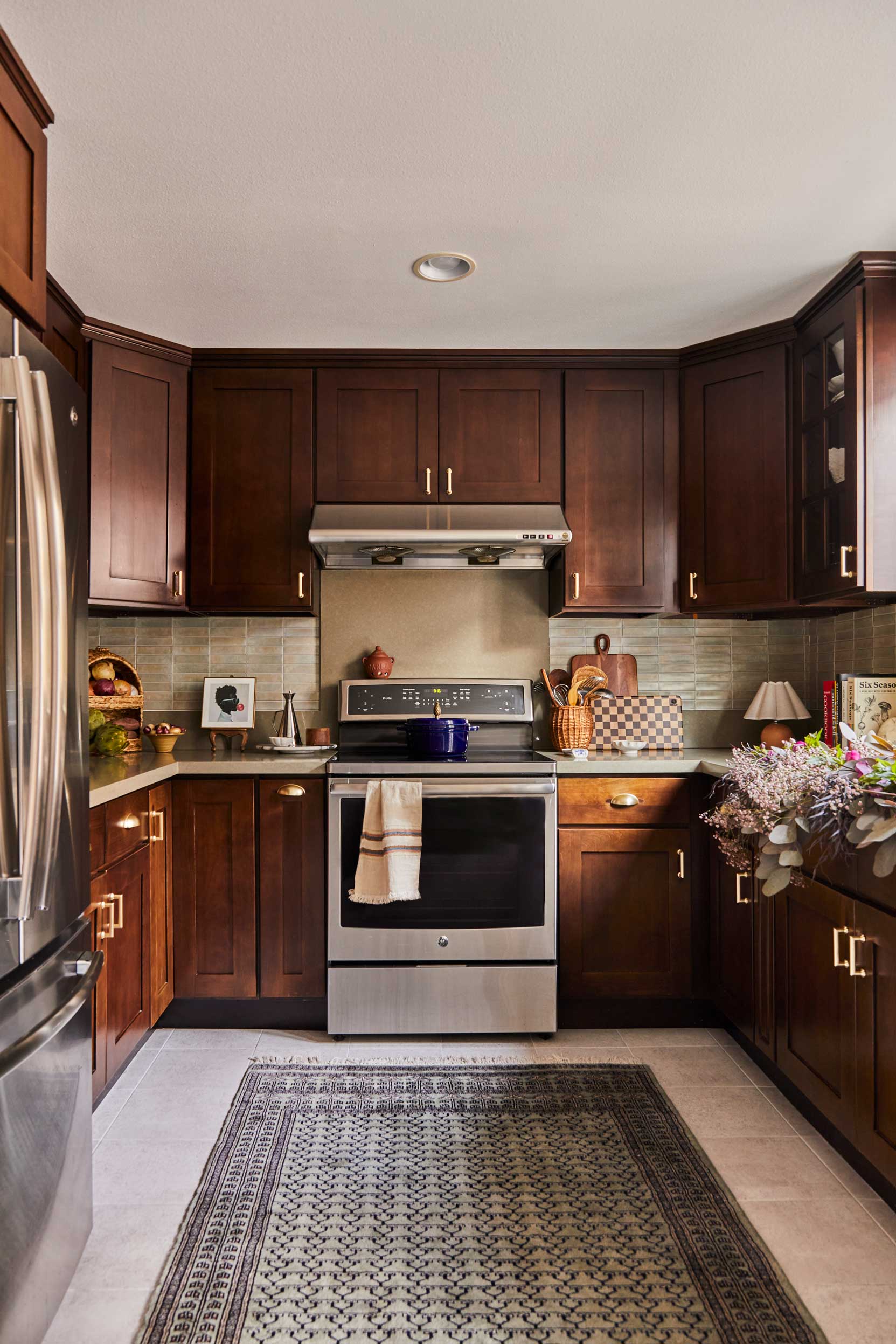
Where I’m coming from (the basic top-freezer model that homeowners loved because of its price), the fridge is a huge upgrade, whether it has counter depth or not. Much of what I initially liked about it can be attributed to its French-door design. I loved the easy access to all areas of the door interior, the wide deli drawer and adjustable shelves.
Shortcoming:
- Less model options to choose from. This was one of my biggest challenges, especially because I needed both counter depth as well as only 33 inches of width (36 inches of width and depth is standard). Luckily, these are becoming more popular, so the supply increases along with the demand.
- They are more expensive, as I already mentioned.
- Reduction in cube storage. You can also expect a counter-depth refrigerator to have a capacity of 17 to 25 cubic feet (LG actually makes some with max-interiors), with the average capacity being around 22 cubic feet. A standard refrigerator is approximately 20 to 30 cubic feet, depending on the style, model, and width.
Now that I’ve been living with this size fridge for over two years, I can say that there have been times when I’ve been frustrated by not having enough space. We’re a family of two adults and a small child, and it’s barely enough room for all my groceries. I usually go shopping for the week and buy things with hope and prayer. Granted, I buy enough groceries to eat for breakfast, lunch, dinner, and snacks for at least six days. Plus, we also keep our big water pitcher there because there’s no water line on that side of the kitchen, so the water dispenser doesn’t work, and I need cold water to survive. If you’re the type of person who only buys groceries for a few meals a week, there’s only one or two of you, or you’re a lot less than me in terms of your spices, milk/drinks, or produce, then this might be fine for you.
In my future kitchen of choice, this size would not be appropriate for my cooking style. I’m sure it would look better at the full 36-inch width, but still, with the “pro” of not losing food in the back of the fridge and making things more accessible, I’d probably choose the biggest fridge I can find as long as it makes sense for the footprint of my space.
,
This is my assessment, but this is a community where all of your opinions are greatly valued (and diverse), so please chime in in the comments below with your own experiences related to counter-depth fridges, for better or for worse.
Until next time, friends…
Opening Image Credit: Photo by sarah ligoria-trump From: Mountain House Kitchen Revealed
